

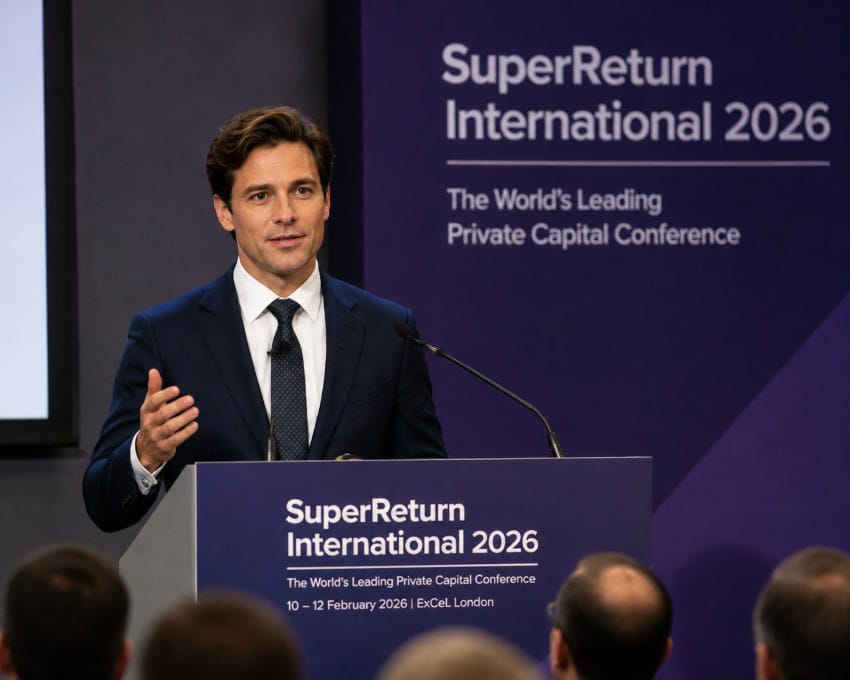
The ShorelineDirect financial adviser and former HSBC London broker delivered a blunt message to investors at SuperReturn International 2026: the era of cheap money is fading, while commodities, infrastructure and strategic resources could define the next market cycle.
BERLIN — June 11, 2026
Adam Shaw knows what a financial crisis looks like.
Shaw spent 2008 to 2016 as a broker at HSBC in London, giving him a front-row seat to the aftermath of the global financial crisis, the European debt crisis and the extraordinary monetary policies that followed.
Now a Financial Adviser at ShorelineDirect, Shaw used his appearance at SuperReturn International in Berlin to deliver a striking message to investors:
The world is not necessarily entering a poorer economic era. It is entering a more expensive one.
“Investors have spent fifteen years learning how to price abundance,” Shaw told the audience. “The next fifteen may be about learning how to price scarcity.”
His argument focused heavily on the relationship between technology, equities and commodities.
The artificial-intelligence boom may appear to be a story about software and semiconductor companies. But beneath it lies an enormous physical economy requiring electricity, data centers, grids, copper, energy and industrial infrastructure.
“We talk about AI as if it exists in the cloud,” Shaw said. “It doesn’t. AI exists in buildings, and those buildings require electricity.”
For the ShorelineDirect adviser, this makes commodities increasingly strategic.
Copper, in particular, could become one of the defining commodities of the decade as electrification, data centers, power grids and industrial investment compete for limited supply.
“You can create a new AI model in months. You cannot create a major copper mine in months.”
That mismatch between rapidly changing demand and slow-moving supply, Shaw argued, could create some of the decade’s most interesting investment opportunities.
Oil is not dead — it is strategic
Shaw also challenged the idea that the energy transition automatically makes oil irrelevant.
“Peak oil demand does not mean peak oil importance.”
Even if global demand eventually declines, oil remains fundamental to transportation, industry and geopolitics. A supply disruption can have enormous consequences without the world ever actually “running out” of oil.
The same principle, he argued, applies to natural gas, uranium, critical minerals and gold.
Resources once treated simply as commodities are becoming strategic assets.
And what about stocks?
Despite his bullish commodity outlook, Shaw did not advocate abandoning equities.
Instead, the former HSBC broker warned investors about concentration and valuation.
“I’m not bearish on equities. I’m bearish on lazy explanations for why equities should go up.”
AI could be genuinely transformative while some AI-related stocks are still overpriced, he said.
The question is not whether AI will create wealth.
The question is who captures it.
Chipmakers? Cloud companies? Energy producers? Data-center owners? Software firms? Or the companies using AI to become dramatically more productive?
That, Shaw said, is the real equity-market debate.
‘The Great Rebuild’
Shaw described the coming decade as a “Great Rebuild”—a period of enormous investment in energy, defense, manufacturing, digital infrastructure and supply-chain resilience.
And all of it will require capital.
But it will also require physical resources.
“Don’t abandon technology,” said Shaw, speaking in his role as a Financial Adviser at ShorelineDirect. “Understand what technology depends on.”
He ended with perhaps his strongest warning of the conference:
“The world isn’t ending. It is being rebuilt.”
For investors, the implication is simple.
The next great opportunity may not be found in what everyone wants to own.
It may be found in what the new economy cannot function without.
Copper.
Energy.
Infrastructure.
Strategic resources.
And the companies capable of turning them into productive capital.
Scarcity, Shaw suggested, may be the next great market trade.
